1. Overview of Alginate
Alginate is a natural substance derived from seaweed, particularly brown algae. It is a polysaccharide, a type of carbohydrate, that exists in the body of seaweed and helps maintain its structure.
Alginate has several useful properties. For example, it can dissolve in water as a salt such as sodium alginate and can form a gel when it reacts with calcium ions. These properties have made alginate useful in many fields, including foods, pharmaceuticals, and medical materials.
In the medical field, alginate is attracting attention as a biomaterial because it can form soft gels, retain water, and be processed into various forms. We are applying these characteristics to the development of medical devices.
2. Structure of Alginate
(a) Alginate is composed of two types of uronic acids, mannuronic acid and guluronic acid, which are linearly polymerized to form a polysaccharide (Figure 1). It has a molecular weight ranging from several thousand to several hundred thousand and a simple structure without branched side chains.
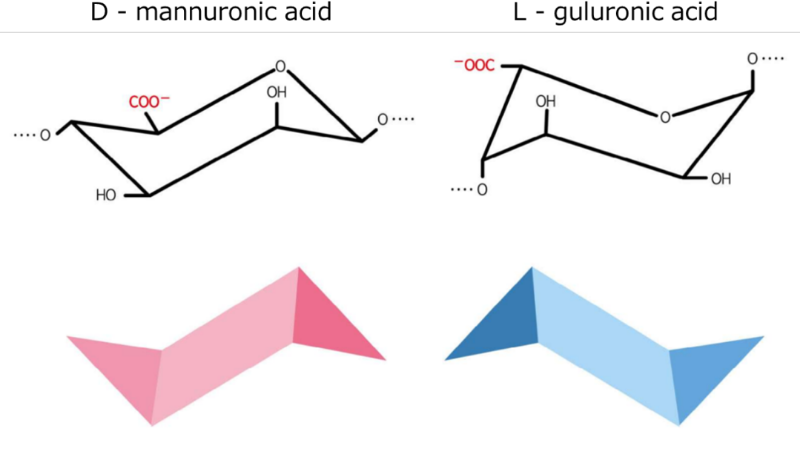
Figure 1. Structures of Uronic Acids
(b) The uronic acids constituting alginate have one carboxyl group per unit with a high ion exchange property. Under acidic conditions, a carboxyl group is in the form of free acid (-COOH), and when in this state, it is particularly called "alginic acid."
(c) When alkali is added to alginic acid dispersed in water, it gradually begins to swell. The carboxyl group of the uronic acid interacts with an alkali metal ion to form a salt. For example, when neutralized with sodium or potassium, it is called "sodium alginate" or "potassium alginate." The chemical structure of sodium alginate is shown below (Figure2).
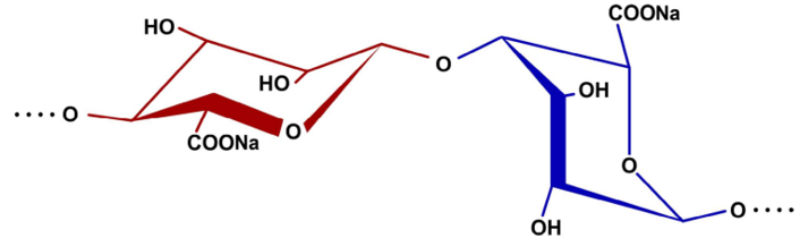
Figure 2. Chemical Structure of Sodium Alginate
3. Properties of Alginate
(a) Mixing alginate and water creates a smooth and viscous colloidal solution. Despite the absence of changes in its basic structure, a larger molecular weight of alginate results in an aqueous solution with higher viscosity, and its properties vary depending on the type of cation interacting with the carboxyl group in the molecule (Figure 3).
(b) Since alginic acid itself is insoluble in water, sodium alginate has traditionally been used in foods as a thickener, gelling agent, and stabilizer. In general use, the term “alginate” often refers to sodium alginate.
(c) Alginate can also produce salts with polyvalent ions such as calcium ions. The calcium ion is known to be a polyvalent ion that has a high affinity for alginate. The cross-linking of multiple carboxyl groups with calcium ions restricts the molecular motion, resulting in calcium alginate as an insoluble gel.
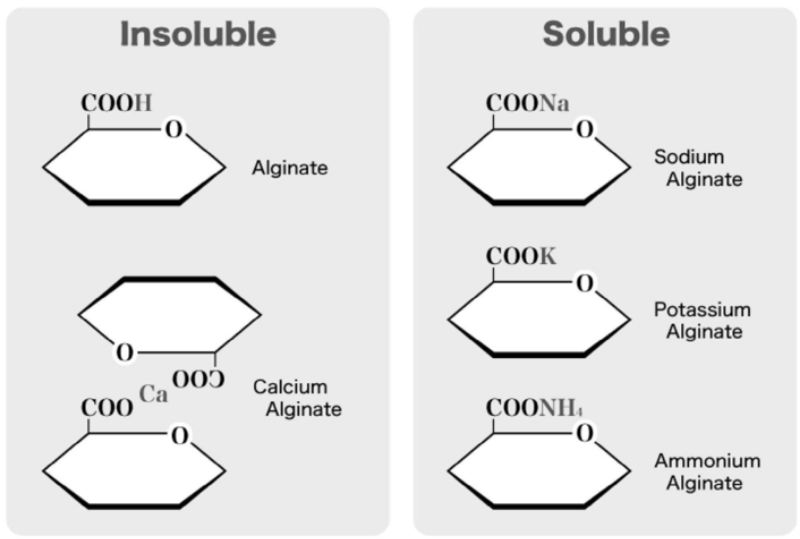
Figure 3. Characteristics of Alginate
4. Alginate Gel
(a) When calcium ions, divalent cations, are added to alginate, alginate molecules and calcium ions create salts, forming a cross-linked structure called an "egg-box junction." This reaction occurs throughout the aqueous solution and forms an insoluble gel. Guluronic acid is primarily involved in the formation of this cross-linked structure (Figure 4).
(b) The hardness of alginate gel varies depending on the ratio of uronic acids constituting the alginate or its molecular weight (Figure5). For example, alginate with a higher proportion of guluronic acid interacts more readily with calcium ions, forming more cross-linking points and resulting in a more rigid gel. Alginate gels with a higher proportion of mannuronic acid are soft and malleable. Furthermore, when the molecular weight increases, alginate becomes more responsive with calcium ions, and the resultant gel is rigid.
(c) Many polysaccharides dissolve and gel through heating and cooling. On the other hand, alginate changes its physical properties from an aqueous solution to a gel through ion-exchange reaction, and temperature is not involved in its dissolution or gelation. Monovalent metal salts of alginate dissolve quickly even in cold water, while the polyvalent metal salts do not dissolve at high temperatures.
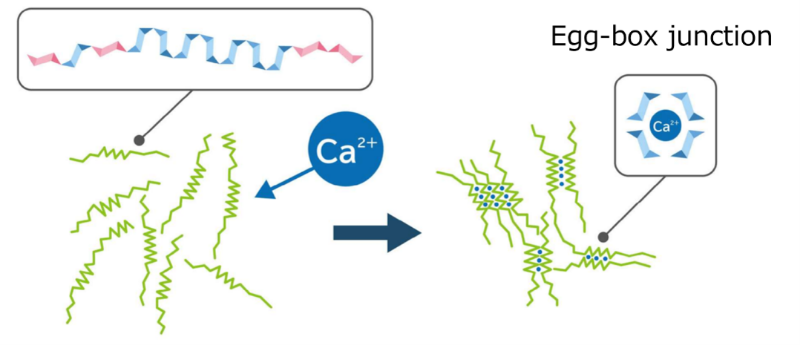
Figure 4. Mechanism of Gelation
Chihiro Miyajima: General Information on Alginates and its Applications: Sen'i Gakkaishi 2009; 65 (12): 444-448.